
This one might be a tough one to swallow.
So if, at any point, you recognize yourself in this… don’t take it as an attack. Remember, people might still value you for many other things. This essay focuses on ONE specific problem. A big one. Admittedly. Often ignored.
You’ll hear things most people around you will never say out loud, at least not with this level of clarity.
And you might want to listen carefully.
Many know that picture:
The man at the center of the room is smiling widely.
The kind of confident smile where the teeth spell BO$$.
On paper, the organization looks impressive. Control. Strong leadership. Everyone knows who is in charge. Officially, there are org charts, governance frameworks, certifications.
All the decorative items that look pretty on a shelf.
In reality, there is: The Person.
Need access? Ask the boss.
Need a decision? Ask the boss.
Need information? Ask the boss.
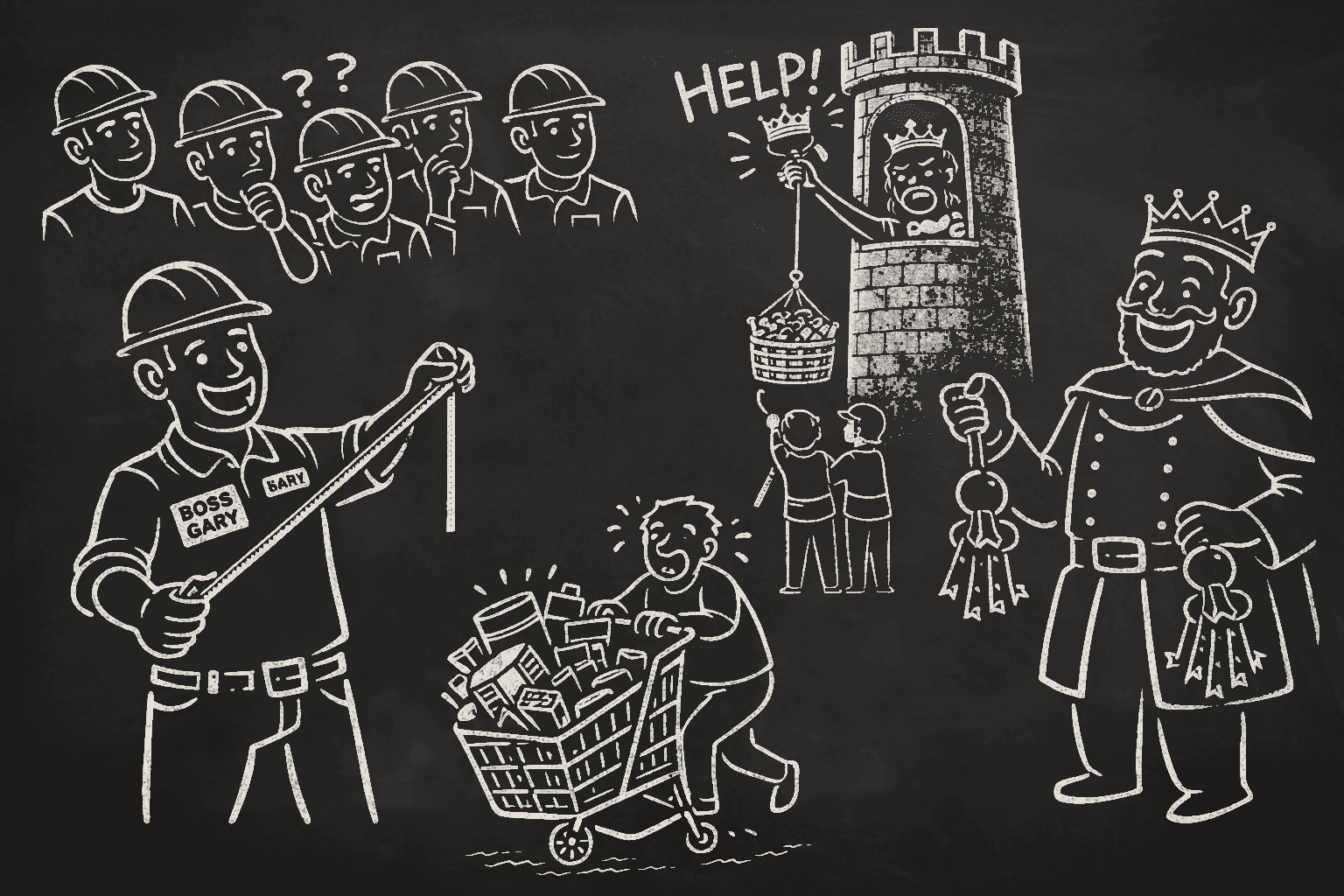
Information piles up near the top like traffic at a toll booth. When The Person is present, things move. As impressive as a shopping cart with one crooked wheel – technically moving forward, constantly corrected to avoid crashing into the shelves.
The organization develops a strange talent: waiting.
Small decisions are folded like paper airplanes and launched toward the boss’s desk.
For a second, the whole office freezes, watching the flight.
Ray Dalio once warned: “And for heaven’s sake, don’t overlook Governance!”
Engineers have a name for it:
Key-man risk.
In some companies, they simply call it: The Boss.
An assistant juggles documents that need signatures.
A manager waits for access to a system that lives inside one computer.
Another carefully rehearses how to confront a simple issue without triggering a debate.
It’s like a construction site where fifty engineers stand around politely while only Gary-the-Boss is allowed to measure the building with a tape. Nothing happens without oversight. Well done! Unfortunately, nothing moves forward efficiently either.
This behavior is often mistaken for control. And to be fair, it is understandable. Many SMEs started as one-man shows, where the founder had to do everything to survive and build something from zero.
But at some point, control must turn into structure. Even if growth is not the goal, obsessive control never becomes a good operating model. It simply makes work harder for everyone.
Every day.
Every hour.
You don’t promote people.
You suffocate them.
Every serious system follows the same rule: remove single points of failure. Because systems built around one critical node do not fail occasionally.
They fail inevitably.
When control becomes the center of a company, it never truly becomes a system. It only looks like one. In reality, it becomes a collection of workarounds. People quickly learn that the bottleneck is a “who” rather than a “what”. The company runs on reminders, hallway conversations, the ancient art of catching the boss between meetings, and the secret skill of “Don’t ask him now.”
As if someone once stood up in a strategy meeting and said:
“Excellent idea. Let’s build a system that stops working the moment one guy goes skiing.”
Soon, someone whispers the most dangerous sentence in corporate life:
“Let’s wait until he’s back.”
It’s like the organization quietly becomes a very expensive waiting room, where every doctor knows what to do, but only one person is allowed to look at the patient’s file. Work moves only because people navigate around the system.
Workaround organizations can survive surprisingly long. Ten years. Twenty. Sometimes an entire generation. But they rarely improve. The moment someone more dynamic enters, the structure cracks. The system must be shaped consciously. Otherwise, you are committing to walking on crutches for the rest of your business life.
You trim your garden, don’t you? So why not cut the grass in your company as well? Everyone likes a clean golf lawn, with a pretty tea area next to a nice fountain.
Businesses are no different.
Good governance assumes something simple: the system must continue to function even when no single person is present to explain it. Good leaders do not try to become the smartest person in the room. They make the room itself intelligent.
That, my friends, is incredibly scary if you love being in charge.
Do not confuse the love of control with the love of hierarchy. From the outside, they look similar. Internally, they run on different fuel. One seeks security. The other enjoys power. Both feelings can become addictive.
Imagine meeting an extraordinary woman you could go all the way with.
But instead of sharing life with her, you lock her inside a room.
You want perfection.
The beauty.
The admiration.
Now hire two hundred assistants, just to make sure she never explores the castle on her own.
That must be love.
They all stand in the same cage. Monitored, restricted, serving a silly purpose. A machine full of capable people with a rotten engine. People either compensate quietly or disappear.
It’s like navigating a military command sending soldiers into a war they can never win. And when too many burn out, new soldiers arrive. The machine continues. Efficiency at its finest.

Join
Medium
What really disappears quietly is the chance to discover what people are actually good at. Instead, employees document their time and prove productivity to your kingdom.
But you don’t ask the real question:
Does the system itself make sense?
Place people in the right environment, and most of them will not need micromanagement. They will simply do good work.
But why do intelligent people build systems like this in the first place?
Habits.
Human brains are remarkably good at sticking to structures – even highly dysfunctional ones.
Consider the extreme deep end: a family with addicted parents. The entire neighborhood has known what is happening for years. Nothing changes. Once something becomes normal, it stops being questioned until a disaster happens.
Organizations behave the same way.
Just instead of fighting, they tiptoe around the issue like Sylvester stalking Tweety.
The harmful pattern once solved a problem – somehow. So it repeats. Until the friction becomes too heavy to carry, or too dangerous to survive.
In healthy systems, decisions and information move like electricity through a circuit – fast and distributed. In boss-centered systems, it is different. It is like hundreds of extension cables running across a crowded office floor. Everyone pretends this is a perfectly normal way to decorate an office.
Here’s the catch: If one person tries to control everything, mistakes compound. Small ones, tagged “low priority.” Everywhere. Suppliers and partners stay professional but are already annoyed. Expecting success here is like running a marathon with a collection of pebbles in your shoes. Impossible.
Now, please take a seat. This one might sting. Everyone shares the second-hand embarrassment. Why? Because someone always has to clean up after Maestro. In reality, that is the definition of codependency.
The first thing this habit quietly destroys is respect. Respect takes years to build and seconds to lose. Most people will not say it directly. Maybe they tried. Yet telling the boss he built a maze rarely ends well for the mouse.
That is not leadership.
That is a human group sacrifice ritual.
At Bridgewater, Ray Dalio introduced a radical principle: Don’t let hierarchy stand in the way of the best ideas. Create an environment in which everyone has the right to understand what makes sense. Leaders must be open to being challenged.
Many successful organizations nowadays rely on exactly that governance framework. Still, some companies believe they can reinvent the wheel, replacing reflection with knowing-it-all.
Isn’t it funny that companies spend an enormous amount of time and money training managers and implementing AI tools? Everyone and everything must improve. Except the person who creatively designed the problem. So before sending employees to the next training or adding new tools, there is a simpler starting point.
The boss improves first.
Surprisingly novel.
Good governance is not proven by how many decisions pass through one desk.
It is proven by how many decisions do not need to.
Unless, of course, you prefer to remain what you have always been:
The Boss.
#Leadership #Management #Governance #BusinessStrategy #KeyManRisk #CompanyCulture #Entrepreneurship #ManagementMistakes #CorporateReality