
What it means
Governance means building principles
not hiring titles
Organizations often try to solve structural problems by adding roles and tools. But governance is not about positions. It is about navigating the ship:
Without clear governance, titles create politics, buzz, and blur. It is not a statement on paper. It is a set of principles that must be served every day.
The Core Risks
Governance fails when organizations allow:
01 — Fiefdoms
Departments protect territory and hierarchy instead of serving the system.
02 — Disoriented Communication
There is no transparent problem culture and little room for candid feedback.
03 — Poor Roadmaps & Processes
Governance is taken too lightly and neglected in daily practice.
These patterns block change, development, and execution.
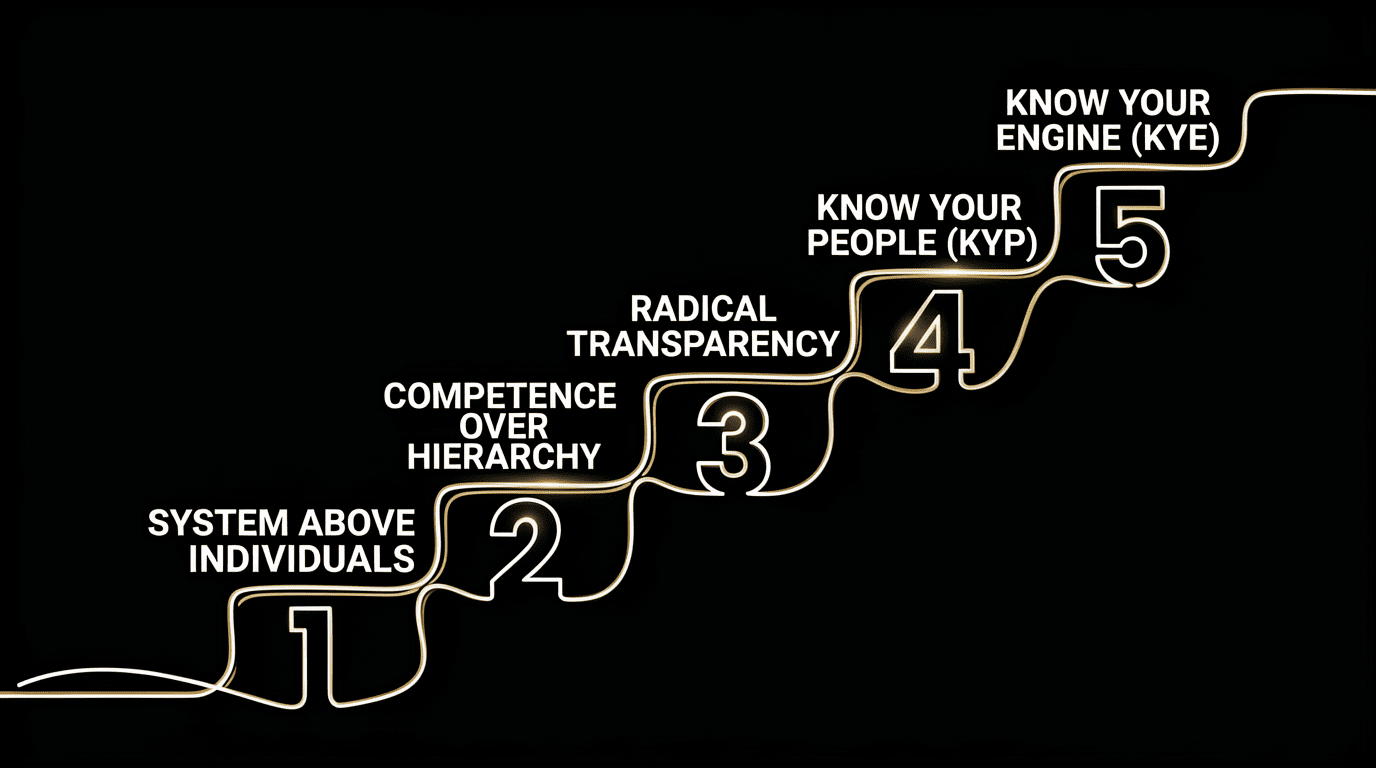
NAVIGATE TOWARDS SUCCESS
Governance Principles
High-reliability systems are built on core principles that allow an organization to adapt, learn, and thrive under pressure. These five interconnected principles provide the structural integrity for decision-making, ensuring that the organization can navigate complexity, innovate, and maintain accountability at every level.
Get Your Team On Board!
What strong governance creates
The Secret of Success
Strong governance keeps the system moving, correcting, and improving itself.
Flow state
Decisions and tasks reach the finish line without interruption.
safety net
Problems surface early before they escalate.
congruence
Roles match responsibility and authority.
self-improvement
The system creates continuous improvement loops.
Governance work inevitably surfaces problems. That is part of the process.
The goal is not to expose people, but to expose the system. Strong organizations address problems rationally and work through them instead of ignoring them. Sometimes this process reveals that roles, responsibilities, or even people do not fit the structure. Leadership must be prepared for that.
How a company deals with these situations depends on its principles, its culture, and what it is willing to tolerate.
Good governance does not create instability. It makes existing instability visible so it can finally be addressed.
Governance changes are prepared with leadership first, before they reach deeper levels of the organization. Positions, responsibilities, and expectations must be communicated clearly so adjustments are understood from the right perspective and do not trigger unnecessary resistance. The goal is not to expose people or weaken strong leaders. The goal is to strengthen the system and align leadership around it.
In most cases, strong managers benefit from clear governance because it removes political friction and allows them to focus on execution.
Governance is not about control. It is about enabling better leadership and better cooperation.
Responsibility and independent thinking are not in conflict with serving the system.
They operate on different levels.
Serving the system is the higher rule and purpose. Responsibility and independent thinking are the mindset and tools that allow people to serve that purpose well.
When both are strengthened, alignment is not enforced – it becomes the natural outcome.
The Library
Perspectives for change.

Hey Alexa – or why AI can’t replace structure
“Hey Alexa, add a 30-min meeting tomorrow at 10 with Neo.”[…]

Oh my, Marie – or the Geometry of Productivity
We all like order. Clean desks. Clear minds. Empty inboxes. A[…]

Where does the dog poop go? – or the Art of not knowing
My name is Wong. I came to this beautiful Western world[…]