
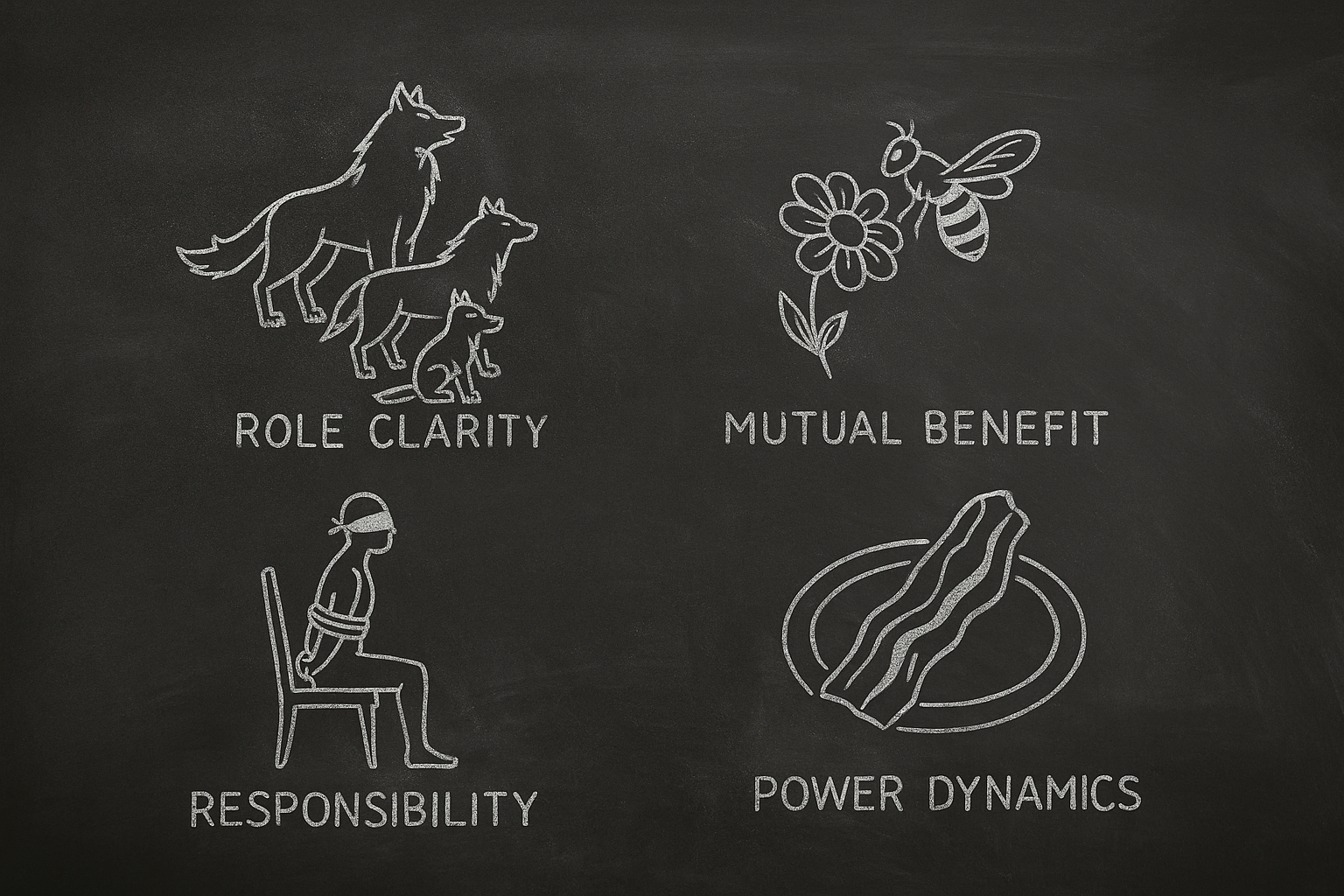
„Universal Rules is a reminder that nature, physics, and dynamics do not negotiate opinions. Those who understand how power and instinct truly operate do not lead through force – but through clarity and an understanding of universal principles. Whether in business, relationships, or a wolf pack – the rules are the same.“
It is fascinating how we instinctively understand certain dynamics and rules in life. We never question how a piece of bacon moves from the fridge to the table, how a wolf pack hunts with precision, or how, in the intimate realm of human interaction, we grasp the balance of surrender, control, and pleasure.
Yet, when it comes to business and daily interactions, we ignore these fundamental universal rules and basic principles of dynamics and hierarchy. Why? Perhaps it’s human arrogance at its peak, believing we’ve evolved beyond such principles. Why do we believe we can bypass physics, biology, and natural laws and still expect harmony? As if we assume bacon teleports itself to the table, wolves use sticky notes to coordinate their hunt, or a blindfolded partner is left to figure out the rules on their own, knocking over furniture. But the truth is, these dynamics, physics, and natural hierarchies govern everything – even our professional interactions. The sooner we accept this, the more efficient, harmonious, and fulfilling our connections and success become.
Let’s step into the wild and look at a wolf pack and its biology. When wolves hunt, there’s no room for confusion or power struggles. They don’t sit around holding meetings, arguing over who should chase the prey or how many votes the deer gets before dinner. The alpha male leads the charge, protecting the pack. Beside him is the alpha female, who plays an equally crucial role – maintaining order within the pack and ensuring cooperation as well as strategy (yes, strategy + female = natural).
The other members? They follow the alpha pair completely. Each wolf knows its role: flankers, chasers, and the final attackers, all working in sync to bring down their prey. All hunters follow, and together they achieve success. Nobody questions the alpha’s authority or tries to negotiate the plan mid-hunt because of an enlightening novel invention. Why? Because clarity of roles and the earned trust in leadership are the only ways they all get to eat. Imagine what happens if a wolf suddenly decides to ignore the hierarchy, or if an alpha folds during a chase, or a female wolf forgets to strategize the prey just to challenge the alpha in the middle of a hunt. Chaos ensues, the pack scatters, the prey escapes, and the harmony collapses. But when everyone sticks to their part, success is inevitable. Each member contributes, earns their place, and the reward is shared – a full belly for all.
Now picture this: a blindfolded partner, your bedroom, the kids finally at granny’s for the day. It is an act of surrender, dominance, and balance. The goal for tonight is clear: shared ecstasy.
But wait, wait, wait. What does that have to do with business? Isn’t that completely inappropriate? It has to do with everything, my friends. This is the very foundation of human interaction. We cannot expect the rules of human behavior to change simply because we change the setting, the lighting, or the room. They don’t.
Whether consciously or unconsciously, humans instinctively sense a disruption of hierarchy, regardless of the context. We know how it feels when it’s right, and we know immediately when it goes wrong. Here, hierarchy is not about dominance for its own sake. It is about each party sticking to their role, or, in other cases, revealing their true nature. So read each word in this paragraph carefully.
In such intimate interactions, everything hinges on instincts and intuition working in alignment. The experience only works when pleasure is pursued truthfully, without crossing boundaries.
Now here’s the catch: Nobody doubts this dynamic – it’s logical. It’s unspoken but understood that anything breaking trust or clarity, like pushing too far, or too fast, or forgetting boundaries, kills the mood instantly. It’s simple, natural, and undeniably effective. It’s a perfect example of clarity in roles and mutual consent, all working together to achieve a shared goal. And yet, when we move into a meeting room or everyday life, we somehow think we can abandon these principles of interaction and still expect success and excitement. Why?
Now let’s dive into the realm of science. Consider Newton’s laws of motion – specifically, the third law: for every action, there’s an equal and opposite reaction. In essence, when one force acts on an object, it generates a force of equal magnitude in the opposite direction – a lesson about consequences. This principle governs interactions everywhere, from the way objects move to how forces balance each other in nature and daily life.
Imagine this: a huge, heavy piece of bacon sitting comfortably in the fridge. It is destined for greatness – your breakfast plate.
But how does it get to the countertop for preparation in the first place? Imagine lifting that heavy piece by piercing it with a single fork. Two forces are now at play: the upward force of your hand and gravity pulling it down. Thickness, weight, and texture decide the outcome. Too much force – and the bacon is too heavy… it rips, leaving you hungry and annoyed. Too little – and the slice is too thin or too slippery to stay on the fork… it falls off, hits the floor, and suddenly you’re cleaning bacon grease off the floor. Yes, we all know that deeply tragic moment of grieving for our favorite piece lying on the floor. Success comes only when forces are aligned and coordinated.

Join
Medium
See, with living beings, we can play the “what if” game.
What if someone changes their mind?
What if behavior shifts?
What if rules bend?
And this, my friends, is the very core of universal rules.
In science, there is no “what if the rules change.”
Gravity will not negotiate.
It will not care or let ego run the show.
It simply is.
The molecules in the bacon do not decide whether to rip or not.
There is no intention.
No opinion.
Cause meets condition – and the result follows. Follow those laws, and success is no longer random.
These laws explain why wolf packs hunt effectively and why intimate dynamics work intuitively. Success, in anything, lies in understanding and respecting the balance of power, consequence, and hierarchy. The dominant’s actions, discipline, care, and leadership must elicit an equal and opposite reaction of surrender and participation from the submissive. In the wolf pack, the alpha’s strength and clarity build the pack’s trust and cooperation. When we work against these rules, chaos ensues. Things will definitely not work well long-term. When we embrace those universal rules, we create harmony. And yes, even bacon tastes better when it’s handled with care.
So why do we fight these principles in business or, for that matter, in our personal lives? The truth is, leadership – whether in a meeting room, a wolf pack, or a relationship – thrives on these fundamental rules. The strongest leaders don’t dominate (sorry, Darth Vader); they guide with clarity and earn trust through action and put their will behind it. And trust, after all, is just another word for knowing enough – but we’ll come to that in another essay. The best teams, partnerships, or even marriages succeed when everyone respects the laws of power.
It’s funny how we humans like to think we’ve transcended the natural rules of dynamics. We invent flowcharts to outdo wolves, form a committee to decide who is responsible for the bacon transfer, and pretend leadership is a democracy of endless opinions. Yet, when it comes to hunting, survival, love, or other essential things, we understand that clarity, coherence, and hierarchy are non-negotiable without needing explanation. Hierarchy, by nature, is not a social construct. In business, these rules create success. In relationships, they create harmony. And no, you can’t reinvent these dynamics. You might just end up like the person who crushed the bacon or scared off the deer.
Maybe it’s time to stop trying to rewrite the fundamental laws of the universe and instead embrace better interdependence between humans and everything we touch in our lives. Act with care and meaning. The universe – nature – already perfected the playbook. And let’s be honest: if the deer had the chance, it might just turn around, laugh at our arrogance, and remind us that the universe’s rules aren’t up for negotiation.
They’ve been working flawlessly since the dawn of time.