
My name is Wong.
I came to this beautiful Western world from a very simple background – a small village, many reasons to smile and laugh, but little else. My parents made sure our bellies were full, that we had everything needed for school, and that we knew we were loved. Enough for me to be able to change my life later on.
I remember how enchanted I was by very simple things: an automatic light in the bathroom, the first time I heard a funny beep when someone opened their car, or staring at a cleaning robot doing its rounds in a supermarket. Buses and trains arrived exactly on time. Everything worked flawlessly. I felt like Jasmine stepping into One Thousand and One Nights.
But one day, walking along the marina, I witnessed something truly strange.
Back home, dogs were mostly wild natural animals. Here, people walked perfectly groomed dogs – on leashes – like elegant accessories. That alone felt a bit unusual.
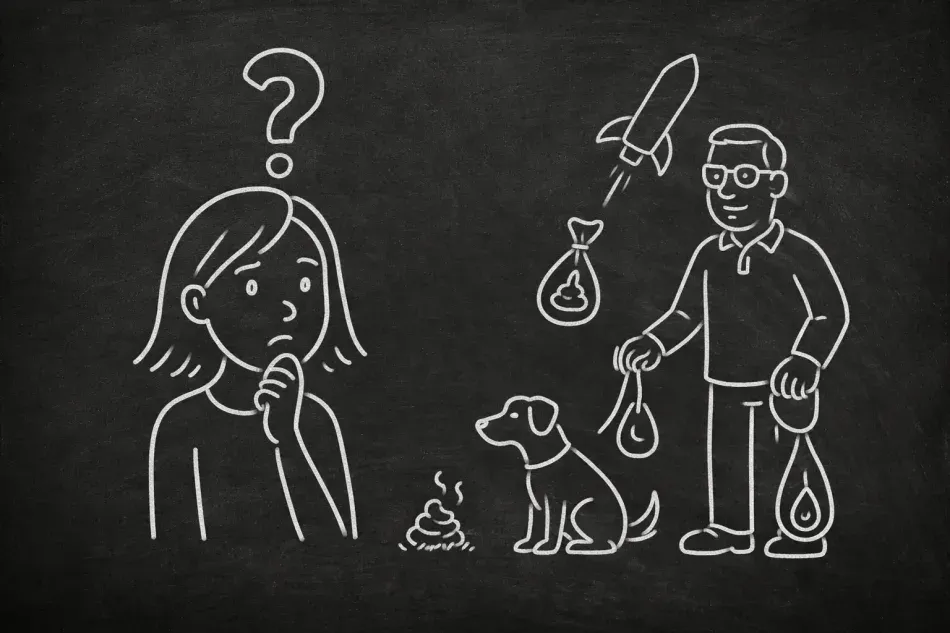
I saw a woman stop and wait patiently while her dog did its business. When the dog was finished creating a textbook-perfect little pile, she calmly pulled out a plastic bag, slipped it over her hand like a glove, picked up the dog poop, tied a neat knot – like a pro – petted the dog for a second and… just walked away with it.
My mind went blank.
I watched in complete disbelief.
Neurons firing, no thoughts landing.
I watched in complete disbelief.
Neurons firing, no thoughts landing.
And then, after a few long seconds, one question pierced the silence in my head:
But… where does the dog poop go?
Some might read this and smile at the cuteness and innocence of it.
But very deep down, this is us.
This is you.
But very deep down, this is us.
This is you.
The fact that we laugh at a story like this reveals a truth: we see the world through our own lens. We assume we know how the world works.
Here is the secret – we don’t.
In highly modern societies, not knowing does not feel neutral anymore. We are no longer used to it. It feels threatening. We panic the second it becomes visible.
Not because we are stupid.
Because we really do not like saying the three most forbidden words in modern adult society:
Because we really do not like saying the three most forbidden words in modern adult society:
“I don’t know.”
The fear of not knowing feels like drafting a goodbye speech to your entire digital life after misplacing your phone for three seconds.
Put a fully grown adult into a mildly unfamiliar situation and watch the collapse.
A restaurant menu without pictures in a foreign country, foreign language.
A cashier waiting.
People patiently standing in line, drawing patterns on the floor with their foot, trying not to let the person at the front feel ashamed.
A cashier waiting.
People patiently standing in line, drawing patterns on the floor with their foot, trying not to let the person at the front feel ashamed.
This same irritated person at the front might use words like synergy and roadmap at work, and is now one heartbeat away from a nervous breakdown over noodles. Defeated by a menu drawn by a minimalist who hates humans.
That discomfort of awkward silence?
That tight feeling in the chest?
That tight feeling in the chest?
That is not knowing.
And here is the funny part: instead of staying open and relaxed, most people immediately switch to judging.
“That’s inefficient.”
“Why do they do it like this? They should do X or Y instead.”
“This makes no sense.”
“Why do they do it like this? They should do X or Y instead.”
“This makes no sense.”
No. It just does not make sense to you.
The side effects are often ignorance, impatience, and a sense of superiority. We yell at poor Microsoft support and then act surprised when the computer magically works after an update restart we ignored for six months.
The system was not broken.
Your natural systems thinking was.
Your natural systems thinking was.
Now watch what happens when this behavior enters relationships.
The absence of two blue WhatsApp ticks can turn people into FBI profilers.
Your partner is quiet. Not distant. Not rude. Just… quiet. And instead of thinking “I don’t know what’s going on yet”, the brain panics and fills the gap like an unpaid intern on caffeine.
“They’re mad.”
“Something is wrong.”
“It’s my fault.”
“Something is wrong.”
“It’s my fault.”
Congratulations. You just turned literally nothing into a full six-episode Netflix thriller.
Nothing happened. No data. Just the unbearable horror of not knowing. So we interrogate. We interpret. We escalate. We would rather be wrong with confidence than open with uncertainty.
Because uncertainty feels like standing in the middle of a room without furniture.
No instructions. No script. No pockets where you can hide your hands.
No instructions. No script. No pockets where you can hide your hands.
So we force meaning where patience would have solved everything by itself. We reward confidence, especially when it is loud – even when it is completely unearned.
And that is usually why we judge others and how things go wrong.
But why do we do this?
Because our brain is designed to create its own reality. Seeing reality as it actually is would overwhelm us.
Just watch the Diary of a CEO podcast episode titled “Donald Hoffman: Seeing True Reality Would Kill Us”. Dramatic statement? Yes. Wrong? Not really.
Your brain is not designed to show you the full truth.
It is designed to keep you functional and alive.
It is designed to keep you functional and alive.
If you perceived everything at once, you would not be enlightened. You would function like a robot. No emotion, just data. Seeing an avalanche coming down the mountain without fear it might hit you would not make you wiser – it would make you dead.
That is why we all have as many realities as fingerprints. The brain does something clever and slightly dishonest. It fills gaps. It assumes.
Those gaps are our cognitive blind spots.
Another expert, Desmond O’Neill, puts it bluntly: even with the person closest to us, we understand maybe 40 percent at best of what is actually going on in their head. And that is on a good day.
Yet we walk around with absolute confidence: “I know exactly why they did that.”
No, you don’t.
You are guessing very loudly, predicting an outcome that will not even be 50/50. Guessing is not the problem. We are human. The problem is that we forget we are guessing and replace curiosity with certainty.
We read one warning label and immediately believe we understand the entire machine – not realizing we are talking about something as little as a nuclear bomb. Half a manual, full confidence – like a seven-year-old insisting the dog ate the homework.
Here is the twist: Most growth and real knowledge flourish in that empty space where you can challenge your assumptions.
We just forgot how to stay there without completely freaking out.“The light is green.”
Sitting in a car, this single sentence can start World War III.
Person A means: green means go.
Person B hears: a ninja assassination: you are incompetent, you are embarrassing me.
Person C hears: I am being managed, you don’t trust me with basic adult tasks.
Person B hears: a ninja assassination: you are incompetent, you are embarrassing me.
Person C hears: I am being managed, you don’t trust me with basic adult tasks.
Three Oscar-worthy performances and the Morse code for: I love you less since the last seven seconds.
It is like watching two YouTube videos about construction and then saying, “Oh, that looks easy. Let’s just move that wall.”
Neglecting that some walls might be load-bearing, but doing it anyway for the sake of flexibility, is a funny-to-watch attempt. Wanting a building without learning how to do it does not make you a visionary. It makes you homeless.
And this is where Wong quietly enters the scene again.
Wong does not panic.
She does not judge.
She does not invent a story.
She does not judge.
She does not invent a story.
She sees something unfamiliar and does the most intelligent thing a human can do.
She asks a simple question to open space for actual knowledge.
She asks a simple question to open space for actual knowledge.
No fake confidence.
No TED Talks.
No TED Talks.
That, my friend, is real intellectual humility.
A masterclass in brain-zen.
Most people, on the other hand, are experts at pretending and punishing those who dare to say “I don’t know”. We correct. We lecture.
We expect children to ask questions.
We admire scientists for admitting unexplored fields or failed experiments.
We praise experts for revising their models for better results.
We admire scientists for admitting unexplored fields or failed experiments.
We praise experts for revising their models for better results.
Yet in daily life – in conversations, relationships, meetings – it suddenly sounds like incompetence.
So we nod at the boss, who is clearly freestyle-presenting his way through three half-remembered bullet points, performing mental gymnastics like Simone Biles in Olympic preparation, and we call it credible leadership.
Strength comes from knowing what you do not know. Certainty starts with asking the right questions, such as:
“Am I really reacting to the facts right now?”
And sometimes, with something as simple as wondering:
“Where does the dog poop actually go?”
Note: Yes, that’s a real question on Google. Look it up and have fun.
Read more on our diagnostics page.