
Let’s talk about greed. That slippery little creature we’re all too embarrassed to admit lives in our heads. Gollum. Desperate. Clutching. Whispering in the dark: “Mine, mine, mine.” It grabs for things it thinks it owns. Your partner. Your colleague’s success. Your neighbor’s lifestyle.
Here’s the problem. Greed is an ugly idiot. It doesn’t think. It reacts, wants, begs, claws, schemes, all for a huge price - your self-respect. And we feed it. Like a paranoid cat. “Yes, baby. Let me fulfill all your dreams.”
Before we notice, we’re hunched over like Smeagol in a cave, clutching a ring that never belonged to us. As I wrote in Universal Rules, there are dynamics that make life simpler when followed. Yet, we often ignore them.
So, Gollum gets promoted.
Starring in a full-blown doomsday soap opera. Red button duct-taped to his chest.
If you feel resistance already, good. It will get worse.
Stay. For your business. For your life. It’s worth it.
Let’s be honest. When we see the fruits of greed, like envy or jealousy, in someone else, it’s instant cringe. We go, “Oh god, no no, don’t do it.” Suddenly, they turn into a chasing animal. A half-transformed werewolf, with snot running outta its nose. We can’t believe our eyes. We feel secondhand embarrassment, pity. Some look for the nearest exit. Others start filming.
So why is it so hard to see when it’s us?
Because up close, it doesn’t look like madness. It feels like justice. Like a fight you need to win.
Here’s the part nobody tells you clearly:
Our reactions make as much sense as yelling at the moon for pulling the tide.
It doesn’t make sense. At all.
Your partner? Not a possession. Your colleague’s promotion? Not your stolen treasure. Your neighbor's new car? Not an act of war. The golden sibling? Not a threat to your life!
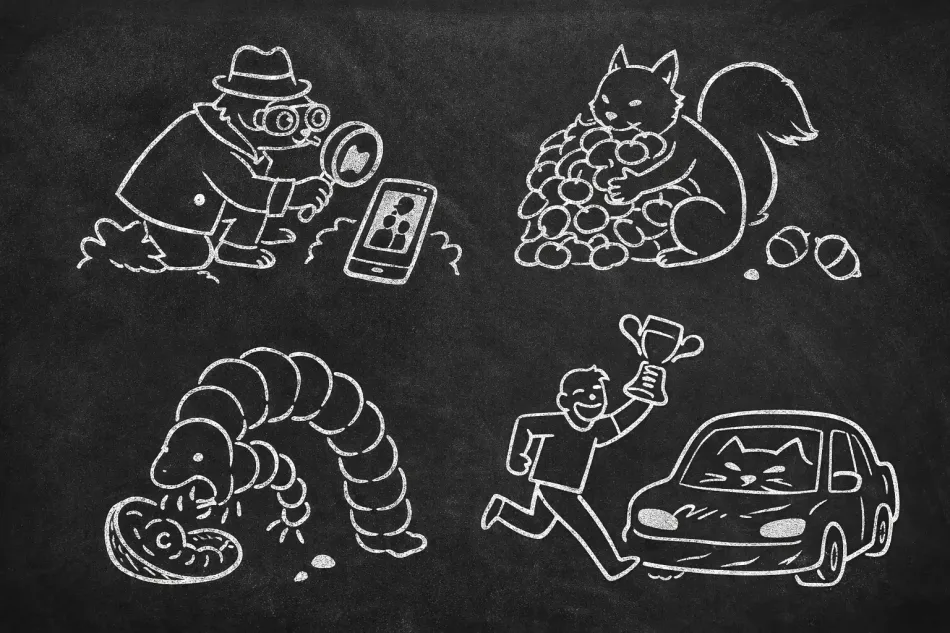
Some might find themselves in this: You’re calm, collected, sipping your tea… until suddenly, you're mentally crawling through your partner's private life, stalking Instagram stories, sniffing for signs, zooming in on shadows like you're enhancing satellite imagery. You become a stalking raccoon in a trench coat and night vision goggles, crouched in the bushes. And where do you end up? Jumping out of a bush like Rambo - only to find… Grandma’s birthday party. With cake. And bingo. And most probably a near-death experience for the old lady.
You suffocate your own fantasies, dreams - very well aware they’re there, desperate to be freed like a genie in a bottle - but you play politics, lock them in a box labeled “What if she/he wants that too?” All just to make sure your partner can’t possibly have it.
It’s like setting your house on fire to keep someone else from lighting a candle.
Genius, right?
So what does that have to do with business?
Let’s turn it around: Why do you think your personality changes once you change the room? Take that same creature out of the cave and put it in an office.
Different setting. Same voice.
Watch how fast cooperation turns into silent territory wars. We ignore this brilliantly. Then wonder why workplaces need better governance, “transparency rules,” and “business culture fixes.”
See, greed is the fire.
Jealousy, envy, control, attention… that’s the smoke.
We don’t see the fire from afar.
We react to the smoke.
You don’t become a different person at work. You just put your instincts in a suit. But that’s the thing about smoke. You can’t hide it. You might first notice it like a secret cigarette in a bathroom. Sooner or later, someone smells it.
But if the fire isn’t extinguished, you won’t be dealing with smoke for long.
You’ll see the fire.
Imagine watching a colleague you worked with for years. Same projects. Same effort. They get the promotion. You’re thinking, “Don’t you just stand there and accept that raise - it’s mine.”
It’s like a bunch of crabs in a bucket. Watch what happens: the moment one tries to climb out, the others pull it back down. Not to save it. Not out of love. Pure survival instinct, sacrificing their siblings just to get out first. Welcome to crustacean logic.
Now let’s bring in science. You can’t argue with science.
Wanting to be like others is like arguing with gravity because someone else got to drop their apple first. But, my friend, your tantrum doesn’t override the laws of physics.
Look at it like this: Your neighbor rolls up with a shiny new car. Being jealous is like stomping back inside, furious, screaming, “Why didn’t the car pick me?” As if their result was created by a vending machine that skipped your number. Zero sense!
The lifestyle we have is a summary and the result of our decisions and the things we do each day. Getting mad at that is like filing a complaint to the moon for pulling the tide. Greed is emotional science denial. That’s not how physics works. And definitely not how life works.
So why do we do things that make no sense?
Because it’s nature. Nature doesn’t ask for your approval.
Under pressure, behavior turns primitive.
For example: caterpillars with a development lag might sneak into the nursery to eat a rival larva, just to secure their chance at the cocoon. No witnesses, no clues, no fingerprints, just a clean metamorphosis monopoly. Savage? Yes. Uncommon? Not at all.
We do exactly the same. Your golden child sibling, the flawless Insta girl, or that friend who always gets the spotlight. It drives you nuts. You feel behind. No roadmap. No control. So you just grab. Larva-level sabotage.
Or squirrels - those twitchy little hoarders, cache food, forget up to 70 percent of where they hid it (it’s true, look it up), and then sneak around stealing from everyone else’s stash. Nature’s software glitch of survival, dressed in fur and unearned cuteness. Sound familiar?
But what do we do with all those faces of greed? Beat poor Gollum with a rolled-up newspaper? Chain him in the basement?
No. We’re not caterpillars on a murder spree. We’re human.
You don’t fix it by pretending it doesn’t exist. That’s spiritual Botox.
Here’s the truth: it’s not a moral failure. It’s a survival setting that kicks in when nothing stronger is available. At its core, it’s a flare gun in your brain screaming: “You’re small. You lack. You’re behind.”
Looking at that hurts.
Good.
Thankfully, we’ve been gifted with a shiny little upgrade called consciousness, which separates us from the cave and lets you live without smearing “baby killer” across the neighbor’s brand-new driveway ornament.
Greed doesn’t make you a monster. It makes you reactive.
The mistake? Thinking it’s right.
Thinking you own things. People. Loyalty. Success. Attention. Even someone else’s thoughts. And the moment you believe that, you start guarding like Smeagol, scratching eyes out for a stupid ring from Mordor.
So no, don’t panic if your partner breathes near someone else.
And no, you don’t win by stealing the award mid-ceremony and sprinting off like a red-carpet fox.
Hilarious, right? And yet, we do it.
So, here’s the weapon - and write it on your forehead in deep dark purple: greed doesn’t make you attractive or powerful, and it does not help you get what you want. It just makes you... small.
The shift is simple. Not easy. Simple.
Stop needing what isn’t yours!
Look at the impulse and say:
“Cute. But not today.”
That’s the moment you stop handing it your crown.
Brutal honesty: greed feeds on low self-worth.
Build your life. Do your work. Close your gaps.
Then something changes.
You gain dignity.
And then, if the worst happens? Someone wins. Someone gets what you wanted. Or for some people, the worst case is a cheating partner.
With a healthy dignity, you don’t collapse. You lean back and think:
“Well, then, go. But please, where?”
That’s power.
The moment you realize, “Wait, that’s not even mine. My reaction does not make sense,” that’s when you win. That’s when it shrinks back into its little cave, mumbling.
Own your life. Your thoughts. Your actions.
Because dignity? That wears way better than insecurity. And unlike greed, it looks amazingly beautiful in every light. But most importantly:
It doesn’t need applause. It’s quiet. It’s calm - and it always wins!
#Greed #CorporateBehavior #Psychology #SelfAwareness #SystemThinking #BehavioralPatterns #Leadership #BusinessPsychology #WorkplaceDynamics #EmotionalIntelligence #SoftSkills #BusinessCulture #TransparencyRules #Governance
Keywords
Governance, workplace, transparency, business culture, behavior
We live in a world where we chase more.
More money.
More clients.
More attention.
Some go further.
The fastest way to lose everything
is trying to grab what isn’t really yours.
The idea.
The partner.
The recognition.
Grabbing feels powerful.
Building feels slow.
That behavior is becoming more visible.
And it’s exactly why companies are pushing for stronger culture, transparency, and honesty.
Because the people who stop chasing “more”
and start taking care of the collective
are usually the ones who end up with the trophies.
Easter is funny.
It looks innocent, but some rituals trigger something much deeper.
Watch kids hunt for eggs.
Some search carefully.
Some run around, grabbing everything.
Some peek into other baskets.
Pure instinct. Running wild.
But honestly, nothing really changes later.
Office instead of garden.
People instead of baskets.
Trophies instead of chocolate.
We love the chase.
Nature wired us that way.
And it’s useful.
Until we let it grow.
What starts as a seed turns into something else.
Greed.
We turn into Gollum.
That ugly, strangely cute creature.
That’s exactly why company culture matters.
It’s not a “nice to have.”
Because once that instinct runs wild, it stops being a game.
It becomes a wildfire.
Your culture framework?
That’s your fire control.