We establish.
GOVERNANCE
For leaders in charge

What it means
Governance Consulting
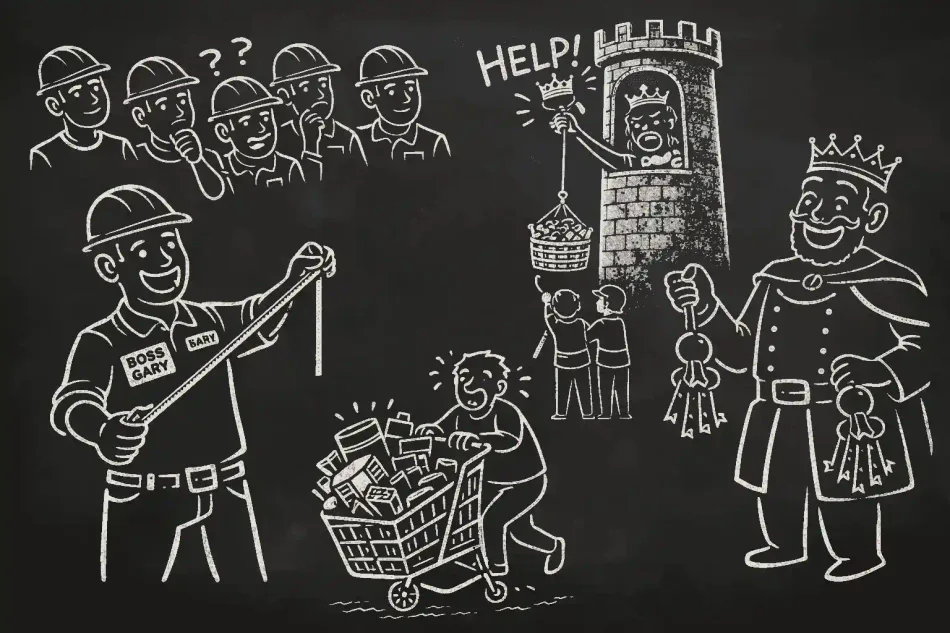
Organizations often try to solve structural problems by adding roles and tools. But governance is about navigating the ship, not hiring titles. Governance consulting establishes clear rules and prevents politics, buzz, and blur: the patterns that block change, development, and execution:
Where governance fails
Fiefdoms
Departments defend territory, not the system.
Disoriented Communication
Problems are known everywhere, spoken nowhere.
Poor Roadmaps & Processes
Governance exists on paper, not in practice.

Build momentum
Governance Principles
Good governance advisory does not create instability. It makes existing instability visible so it can finally be addressed.
High-reliability systems are built on principles that allow an organization to adapt, learn, and continuously improve. These principles become an accountability framework: we lock in the operational parameters so your organization runs like clockwork, even during rapid scaling.
The five principles
Get Your Team On Board!
SAI
System above individuals

COH
Competence over hierarchy

RAT
Radical transparency

KYP
Know your people

KYE
Know your engine

The benefit of governance consulting
The Secret of Success
Solid principles that survive change and are easy to follow in daily operations keep the system moving and correcting itself. Problems surface early, roles match responsibility, and decisions reach the finish line.
These are the relevant factors that make the new design hold under pressure. With the rules in place, technology becomes an option instead of a risk.
Explore AI readiness→book a call
f.a.q.
Frequently asked questions
We reorganized and nothing changed. What did we miss?
A reorganization moves boxes. It rarely moves authority. If the same person still has to sign off, the new chart describes a company that does not exist. Governance consulting starts one level below the chart: with who may decide what, and what happens when they get it wrong. Until that is settled, every structure you draw will drift back to the one you had.
Every decision still comes back to me. How do I change that?
Delegating tasks does not delegate authority. What keeps decisions at the top is rarely workload. It is unclear decision rights. Nobody below is certain they may act without asking, so they ask. The fix is concrete. For every decision that repeats, write down who decides and where their limit sits. A number, not a principle. Managers use authority they are sure of. They hand back the kind they would have to defend.
My managers agree in the meeting and do something else afterwards. Is that a governance problem?
Usually, yes. Agreement in a room is cheap when nothing attaches to it. An accountability framework attaches something: who carries the outcome, when it gets reviewed, and what happens if the decision turns out wrong. Without that, the meeting is the last point at which the decision exists. Nobody is being difficult. They are reading, correctly, that the decision has no owner, or that it was never defined clearly enough to act on.
How do I give my leadership team real authority without losing control?
Control does not come from holding decisions. It comes from knowing how they are made, and how clearly they are defined. A governance framework sets the basis: the criteria, the limits, and the point at which something has to come back to you. You govern the rules instead of the cases, which is most of what governance advisory actually delivers. Owners usually find they were never controlling the decisions anyway, only slowing them down. Vague wording is the usual reason. It reads well and sends every case back for another round.