
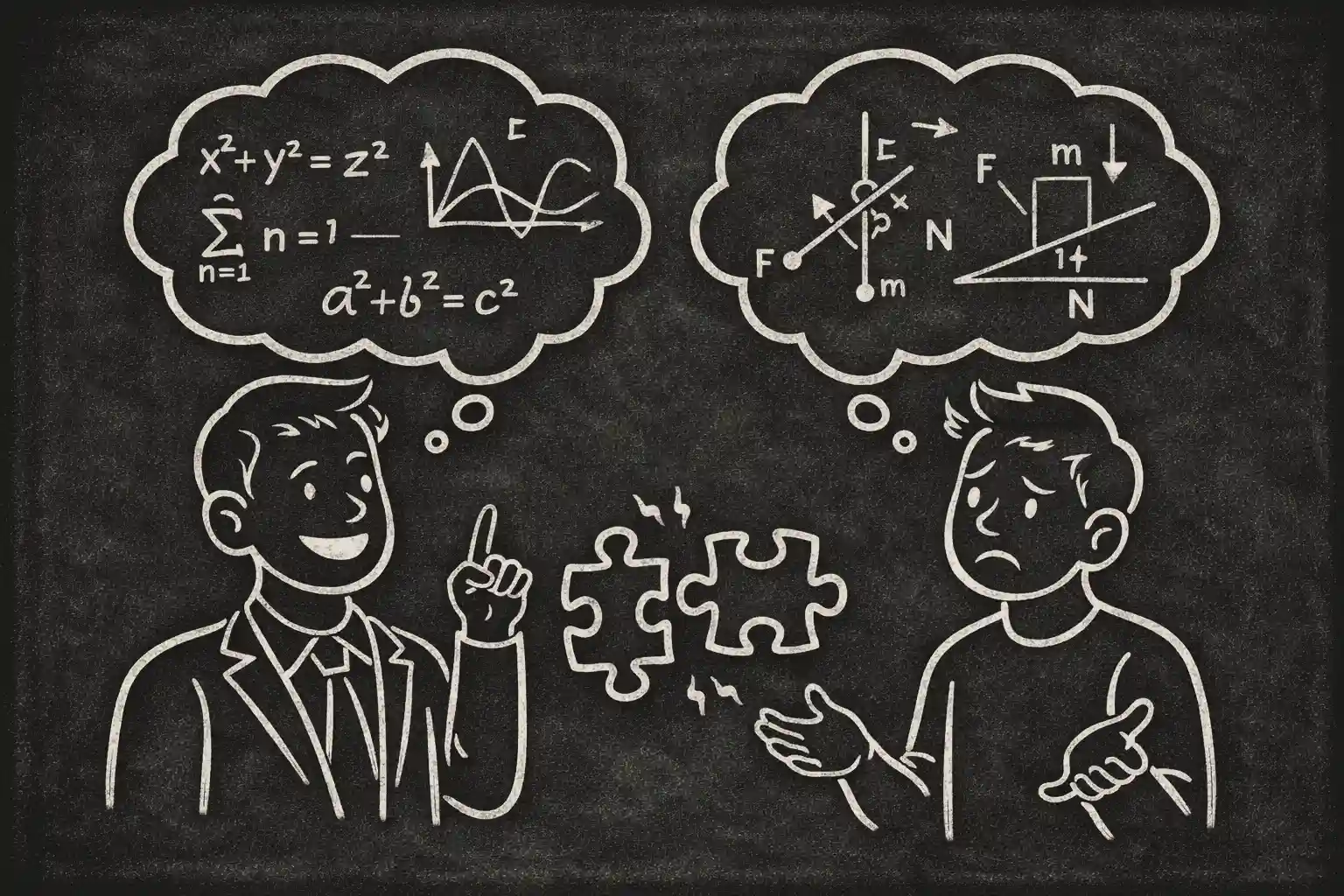
Put two highly intelligent executives in a meeting room. Clear thinking. Problems get sliced open like Bruce Lee cutting through a stack of wooden boards.
The kind of people who become very, very good at being right. They connect things more cleanly. See the ending while others are still looking for the remote. That’s how they got where they are. It’s an incredible skill.
But then it cracks.
A shift in tone most participants won’t even notice. From a rational perspective, nobody is really wrong. But still, something starts to drift.
See, intelligence does something dangerous when it’s left unchecked. It doesn’t just solve problems. It starts protecting its own version of the truth - like a child with a smeared face insisting it didn’t eat the chocolate.
That’s what happens if you never develop an IQ switch.
Now watch how it unfolds.
Over time, this level of thinking comes with side effects. These people start listening less. Not because they don’t care, but because they see the outcome earlier and automatically filter out anything that feels like fluff.
And that’s where a gap opens.
The sharper the logic, the easier it is to miss the human layer.
Here’s the thing. An IQ switch has nothing to do with intelligence per se. It’s the ability to shift from what is correct to what the other person sees and wants. And that’s exactly where people get stuck.
Picture this: You sit in a meeting with a client, thinking: good, someone who gets it. No small talk. For a moment, it feels like watching two surgeons who don’t need to speak. You look at the problem and structure it instantly. The moment you start talking it through. Step one, two, three. Clean. Done.
And suddenly… your client looks at you like you confidently brought scissors to open-heart surgery.
Awkward silence - and the realization that their step one is simply not your step one. You start pointing out each other’s inconsistencies as if one of you is putting on socks after shoes and calling it a routine.
And suddenly, the problem isn’t the problem anymore.
You’re not solving.
You’re defending sequence.
And this is where a very precise mistake begins.
Better arguments. More logic. As if you’re explaining gravity harder while someone insists the floor is optional.
But logic is not the issue.
Order is.
And sometimes order is personal. It exposes what someone protects or quietly avoids touching. Miss that… and you get friction that politely smiles at you while sharpening a knife under the table. It’s like a tailor insisting on skinny jeans for a client who clearly looks uncomfortable trying to walk in them. Who would do that?
In those moments, the switch is crucial.
You need to step out of your own structure just long enough to see theirs. Once the consequences are clear, the order of a process becomes almost non-negotiable.
Like anesthesia in surgery. You don’t “see how it goes.” There is an order.
Sedate. Stabilize. Operate.
Switch it… and your brilliant technique turns into a horror show.
Without that clarity, even the best solution looks like someone trying to sneak into the room while everyone is watching.
Technically, a possible strategy.
Socially… dead.
Now, another phenomenon is something as simple as speed.
You can be fully aligned.
Same direction. Same logic.
Suddenly, one sentence lands like slow poison.
“We estimate implementation in about five months.”
Nothing wrong with that. But it hits somewhere else entirely. They’ve been in this for five years. Fixing. Failing. Rebuilding. Pouring sweat into it like it’s a classified special-ops mission. And now you walk in and compress it into months.
From your side, it’s clarity. Something you’ve done a hundred times. From their perspective, it feels like you just erased the entire journey. Like telling someone lost in a maze for years that the exit is “simply right there.”
The unspoken reaction:
“If it was that simple, why are we still here?”
Relief… or anger. They don’t know yet. One thing is clear: you just shook their entire frame, like picking apples from their tree without asking.
Sometimes speed doesn’t just mean efficiency. It questions effort, loss, and history. Speed becomes a threat.
So new things start to appear like gremlins you accidentally fed after midnight.
More questions.
More control.
Resistance.
Not because they don’t want the solution.
Because they don’t accept the speed.
And that’s where the switch becomes your lifesaver.
You have to meet people where their reality is. Otherwise, you don’t move the project forward. You just crash-land on Mars.
From that moment on, it sits there, quietly:
“They don’t understand how serious this is.”
Then there’s the beautiful art of framing.
The agenda clearly says: leadership needs improvement. Sales need to increase. Let’s do some training. You listen. You nod. And already know… well, that’s not it. Because what they describe is the symptom. You see a system that can’t carry high performance, no matter who you put into it.
That’s the moment things get tricky.
Because telling someone at that level that they framed the problem wrong is extremely difficult. It doesn’t land as clarity. It lands like telling a magician mid-show it’s just a trick you haven’t figured out yet. For them, it feels like a direct insult.
And that creates instant friction.
Not something you can quote.
Just a clear shift in the room.
And now you’re standing at a fork.
Push against it or let it run.
Either way, you’re in a perfect double bind. Neither option is right, and both come with risks on your end.
So what do you do?
You need to make sure they discover the real problem “on their own.” Walk them through their own approach in a way that makes the gap visible.
And that’s when the shift happens. (Or not.)
Not when you were right.
When they are ready to see it.
Your job here is to stay completely neutral about the outcome - not to spend your energy proving a point. Sometimes that means offering a cosmetic solution (while securing yourself by clearly communicating what it is) and delivering exactly what was asked.
So who sells those pretty little switches?
Nobody.
You build it.
Some learn it early by becoming parents. Try explaining logic to a five-year-old crying over a teddy bear. Perfect argument. Zero effect. Some learn it the other way around, realizing your parents don’t need to understand everything for things to work. Others learn it the hard way. A relationship breaks. A team quietly falls apart. Good people leave like a SpaceX launch - fast and expensive.
Same lesson. Different entry point.
The move is simple. Not easy.
Let go of always being right.
Not everything in life is about being accurate.
In fact, sometimes that’s exactly what’s wrong about it.
You can destroy a great relationship or team dynamic with that single annoying habit. You can win every argument and still lose the room. It’s like playing chess alone and declaring victory. You’ll also miss highly valuable opportunities and solutions you didn’t even know existed, because you were busy explaining quantum physics in a painting class.
The most painful long-term consequence?
You lose people’s real respect.
And with it… the very thing you were trying to protect: being right.
Reality is not just facts. It has layers. Emotions. Values. Timing.
Ignore that and you don’t sound smart.
You sound like someone bringing a calculator to a first date.
If you only operate on logic, you’re not seeing reality. You’re seeing a small part - your version of it. Step up a level. Stop arguing inside the problem. Look at what exists around it. What happens between people and words. That’s where things actually move. Try to truly understand, not just say it better. People will see through that and read it as manipulation.
Sure, you might survive longer. Some do.
But you’ll fail harder in the long run.
One very powerful tool that works is curiosity. Real, pure, innocent, deep curiosity. Even for things that feel completely wrong to you.
THAT is the switch.
That is the moment people feel understood.
And maybe you’ll experience something new… They start listening back.
#IQSwitch #IntelligenceTrap #BeingRight #Leadership #Communication #DecisionMaking #Psychology #HumanBehavior #CriticalThinking #SelfAwareness
Ever had a conversation in a meeting where everything sounded right… until nothing moved?
That’s usually the moment you’re not solving the same problem anymore.
It’s not about logic.
Not about skill.
It’s about what actually matters to the other person.
Sometimes the fastest way forward isn’t a better argument—it’s understanding what’s between the lines.
When did logic last fail you—and something else worked instead?